Japan
What the source says
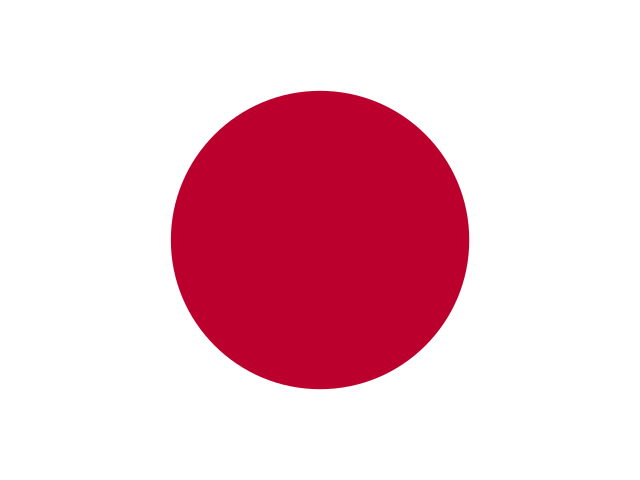
Referenced, awaiting primary-source reviewDe facto use from 1870; official law 13 August 1999 (Act on National Flag and Anthem). The red disc represents the sun; the flag embodies the country's sobriquet, the Land of the Rising Sun. Officially called the Nisshōki ("flag of the sun"), but more commonly known as the Hinomaru ("ball of the sun").
Referenced, not verified: a secondary work states this, and the document that constitutes the flag has not been read for this entry. What the marks mean.
Colors and meaning
White(r1) #FFFFFF
Symbolism and history(r1)
A single red disc, officially the Nisshōki ("flag of the sun") and commonly the Hinomaru ("ball of the sun"), centers a plain white field; used as a merchant flag from 1870 and given legal standing in 1999.
Most similar flags
The 6 closest of the 194 other national flags, ranked by a similarity index computed from the flag images themselves. The number is that index, 0–100 — not a claim that the two flags are “X% identical”.
 Georgia87
near-identical colour proportions.
 South Korea87
the same colours in similar amounts.
 Cyprus85
the same colours in similar amounts.
 Panama75
the same colours in similar amounts.
 Finland70
similar colours in a different arrangement.
 United Kingdom69
similar colours in a different arrangement.
From this entry, not from the index: Its single centered disc on a plain field is echoed structurally, though not in color or placement, by Bangladesh's flag.
Computed at build time: each flag is rasterised to 64x48, and the score is 0.55 × colour overlap + 0.45 × structure. A different weighting would rank these differently. How the index works.
References — not verification
(r1) Referenced to Flag of Japan (Wikipedia (English)) on 2026-07-17. States the adoption year, which colors the flag has, what the colors mean and the symbolism and history on this page. The passage it states them in is quoted at the top of this entry.
Further reading: Flag of Japan on Wikipedia